
 >
>
The videos on this page are for informational purposes only. They do not replace a consultation with a qualified healthcare professional.
These exercises must be performed only with the agreement and under the supervision of a healthcare professional (osteopath, midwife, IBCLC consultant, speech-language therapist, physiotherapist…). Every situation is unique — a personalised assessment is essential before beginning any exercise.
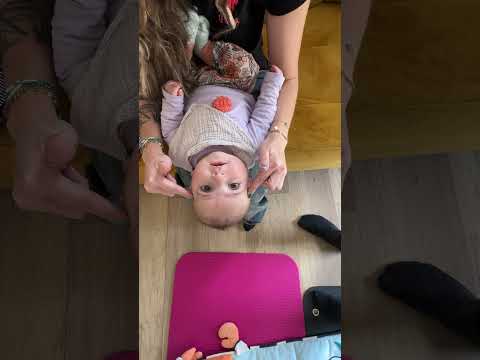
Massage your baby's face, especially around the lips, to relax the muscles and release tension. You can also use a face rhyme with rhythmic tapping to gradually reduce the gag reflex.
Place your baby facing you and gently massage around the mouth, cheeks and nose in rhythm with a little song.
 ▶
▶
Face rhyme
When your baby is sleeping or calm:
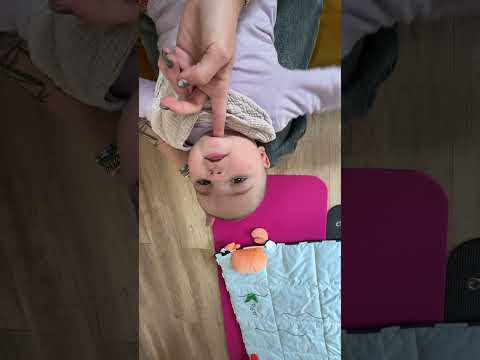
This exercise relaxes the tongue muscles and, gradually, stretches the tongue-tie.
 ▶
▶
Chin massage
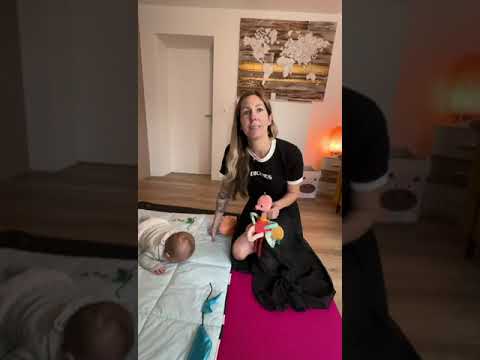
Place your baby on their tummy and get them to follow you — or a toy — with their eyes to the left and right.
No need for long sessions: several short moments throughout the day are sufficient. Tummy Time strengthens the neck and back muscles and improves overall posture, which has a positive impact on the oral sphere.
 ▶
▶
Tummy Time
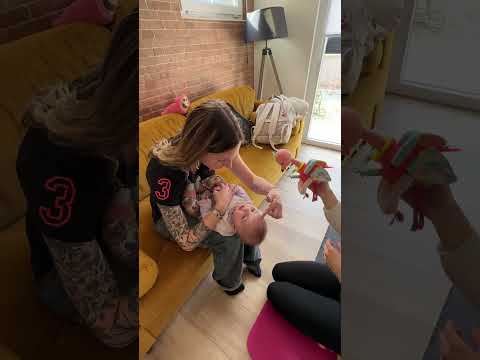
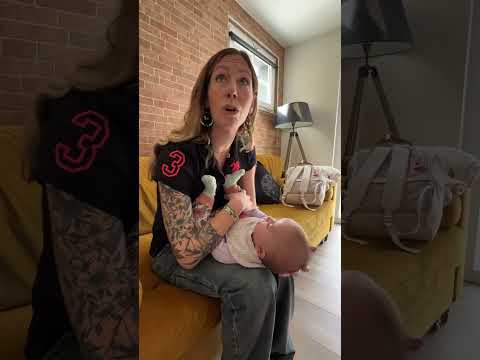
Place your baby on your knees with their head hanging back slightly, holding their legs bent against you.
Another person takes a toy and turns their head to the left and right, or gently guides their head from side to side several times.
This exercise promotes cervical mobility and releases neck tension, which often affects sucking.
 ▶
▶
Guppy
 ▶
▶
Guppy 2
Remove the dummy from your baby once they are asleep. This simple habit can have several benefits:
The aim is simple: to accustom the baby to intra-oral manipulation and prepare the tissue before the procedure. Several exercises can be performed:
Place your baby facing you and massage their face: touch the nose, lip and chin to encourage them to open their mouth. Then place a finger in their mouth to massage the gums with a sweeping motion, gently tickling the tongue.
This exercise accustoms them to intra-oral contact — valuable preparation for the frenectomy and subsequent care.
Place a finger under the baby's tongue and move it from left to right.
⚠️ In babies with a very anterior frenulum, it may not be possible to pass from one side to the other — in this case, move along one side, then the other. After the frenectomy, you will be able to move freely.
 ▶
▶
Under frenulum massage
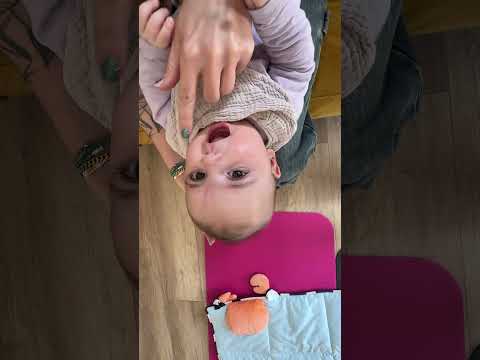
Place your thumb or index finger under the baby's chin and apply light pressure (it should not be painful). Massage this floor of the mouth for about 7 seconds.
By reflex, your baby should raise their tongue towards the palate. Open their mouth to check: the tongue should stay pressed against it for a few seconds.
Some babies with a very restrictive frenulum are not yet able to raise their tongue — this is completely normal.
This exercise can be performed while the baby is sleeping.
▶
Chin massage
These exercises are essential to prevent the frenulum from reforming. They must be performed according to the precise instructions of your practitioner.
The exercise is the same as before the frenectomy — but it is crucial to continue it for up to 6 weeks after the procedure.
It allows the tongue to regain full upward mobility, to rise to the palate, and prevents the frenulum from reforming.
After the frenectomy, your baby should keep their tongue against the palate for about 10 seconds.
▶
Chin massage
Massage your baby's gums to stimulate lateral tongue movement — its ability to move from left to right, which is essential for effective sucking and good future feeding.
With your finger, without touching the scar, pass on either side of the frenulum scar to massage under the tongue.
This exercise is very important to prevent the frenulum from reforming. You can begin 3 days after the frenectomy.
▶
Under frenulum massage
Continue removing the dummy once your baby is asleep. This promotes better tongue positioning and supports the benefits of the frenectomy.
Our trained professionals are available to show you the exercises suited to your situation and to accompany you at every step.